Mexican wines and grapesBaja CaliforniaGuanajuato
They Make Mexican Wine: The Women Winemakers Changing the Industry
From Santo Tomás to Parras and San Miguel de Allende: the women behind Mexican wine, what to taste from each one and how to visit their wineries.

In the Ejido El Porvenir (a community of shared farmland), in Baja California, Mexico, pink signs mark the dirt road to El Corcho Rosa, the tasting room of Valle Girl Vino. You taste there with the winemaker who makes the wines. Sitara Pérez filled her first six barrels in 2012, and every label from the house carries the name of a female character, from La Traviesa, a Grenache, to La Atrevida, a Syrah with two years in barrel. The scene says a lot about women in Mexican winemaking: they are in the cellar, on the label and behind the bar.
None of this began yesterday. Laura Zamora took over the winemaking at Bodegas de Santo Tomás in 2000. Three students of La Escuelita, Hugo D'Acosta's winemaking workshop in El Porvenir, founded Vinícola 3 Mujeres in 2005, and Natalia Badán has run her family's house in Guadalupe Valley (Valle de Guadalupe) since 2008. What is new is how many names there are now and in how many places: the profiles on this site list women winemakers at wineries in Baja California, Querétaro, Guanajuato, Coahuila, Aguascalientes, Hidalgo, Jalisco and Chihuahua.
How many women make wine in Mexico?
There is still no public figure we can cite. We found no count of the country's winemakers by sex, either from the Consejo Mexicano Vitivinícola (the Mexican wine council) or from the schools, and the bachelor's degree in enology at the Universidad Autónoma de Baja California, in Ensenada, only began in 2019. Percentages circulate in press notes, but none with a source anyone can check, so we do not repeat them here.
What we can offer is our own map. As of September 2026, the profiles in this directory name more than twenty women who make wine or run a winery: in-house winemakers, like Cristina Pino at Santo Tomás, founders who sign their labels, like Claudia Horta at Casta de Vinos or Verónica Santiago at Viñedos Mina Penélope, and consultants who run the winemaking of several houses at once. It is a count of what we have documented, not a national statistic.
Who are the winemakers changing Mexican wine?
Six profiles, written from what their wineries' profiles and public sources say, each with what to taste and how to get there.
Laura Zamora: from the lab to her own winery
She joined Santo Tomás, the house founded in 1888 south of Ensenada, as a lab technician. In 2000 she took over the winemaking, put in 38 years at the winery and went on to direct its production. In 2017, a consulting job that she was paid for in grapes gave her her first wine of her own, and in 2019 she formalized Casa Zamora with a partner, in the Ejido Ajusco. That same year Cristina Pino, a winemaker from Extremadura, Spain, replaced her at Santo Tomás.
- What to taste: Cofa, a Barbera from the Valle de Santo Tomás aged 12 months in French oak barrels.
- Before you go: her profile does not yet confirm whether she is still making wine or whether the house receives visitors, so write first.
Lulú Martínez Ojeda: one signature on three houses
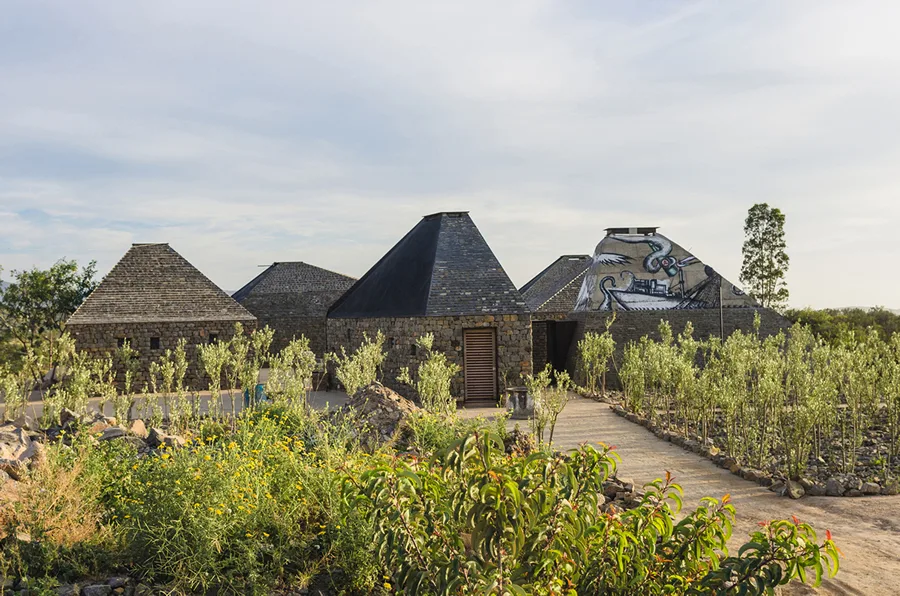
Born in Ensenada, she trained in Bordeaux and did an internship at Château Brane-Cantenac. She signs the wines of the Bruma winery, a miniature wine village in Guadalupe Valley with architecture by Alejandro D'Acosta made from recycled materials. Since 2016 she has advised Viñedos Aldo César Palafox, in the Valle de la Grulla, and in 2025 she joined Santo Tomás as a consulting winemaker.
- What to taste: Bruma's Plan B GSM+N, which adds Nebbiolo to Grenache, Syrah and Mourvèdre, or Quercus, the barrel-aged Chenin Blanc from Palafox.
- How to visit: Bruma has a tasting room, a restaurant and a hotel. Palafox serves its tastings in the underground cellar or among the oak trees.
Natalia Badán: the memory of a ranch
She grew up on the ranch that her family, of Swiss and French origin, built from scratch in the 1950s, long before the valley's boom. Her brother Antonio, an oceanographer, made the wine for years. Since his death in 2008, Natalia has run Vinícola Mogor Badán with her children. The house is known for a dry white from Chasselas, the Swiss grape the family brought, and for a Bordeaux-style red meant for cellaring. Of the 2020 harvest, she suggested opening it from 2025 on.
- What to taste: the Mogor Chasselas and, if you come across one, a red from the house with years in the bottle.
- How to visit: tasting in the underground cellar, at the km 85.5 marker on Mexico Federal Highway 3. With no confirmed website or phone number, write on Facebook before you go.
Natalia López Mota: natural wine under a hacienda
In an underground cellar at Hacienda La Romita, on the outskirts of San Miguel de Allende, she signs the wines of Cava Garambullo, which she runs with Branko Pjanic. They buy organic or biodynamic grapes in the Bajío, ferment with native yeasts, neither fine nor filter and use barely any sulfite, sometimes none. In our guide to natural wines we explain what each of those terms means. She also leads open talks about the craft.
- What to taste: Rover, a skin-contact orange wine, or Ventura, one of the short-run Mexican pet-nats.
- How to visit: by reservation only, and the winemakers themselves lead the tasting.
Trinidad Jiménez: Syrah bubbles facing the Peña de Bernal
With a doctorate in viticulture and enology from the University of Turin, she worked in San Miguel de Allende and as an assistant in Querétaro, the United States, Portugal and France before taking charge of the winemaking at Puertas de la Peña, about five minutes from the center of Bernal. In the semi-desert of Querétaro she makes a rosé sparkling wine from Syrah alone and a white that splits Macabeo, Xarel-lo and Muscat in equal parts.
- What to taste: Encuentros, the Syrah sparkling wine, and Abuelo Julián, a Malbec aged 14 months in barrel.
- How to visit: a tour of the cellar and the vineyard. The estate has a hotel with a spa and a restaurant.
Lucía García Alonso: the barrels of Parras
She arrived in 2018 at Vinícola Parvada, in Parras de la Fuente, after working harvests in Chile, Spain and Germany, and that year the house's first wines went on sale. Each harvest she chooses the barrels that tell it best for the Selección del Enólogo (Winemaker's Selection). The Reserva 2018 won a Grand Gold at the Concours Mondial de Bruxelles 2022, along with the title of Vino Revelación de México (Mexico's Revelation Wine).
- What to taste: the Reserva, made from Cabernet Sauvignon, Syrah and Tempranillo, and the Cardenal, a young red from Caladoc and Malbec.
- How to visit: tours with tastings, booked on the house's website, with a restaurant and a hotel in the same complex.
How did 3 Mujeres and Valle Girl, two women's wineries in Guadalupe Valley, begin?
Both say it in the name. 3 Mujeres (three women) was born of a friendship: Ivette Vaillard, Eva Cotero Altamirano and Laura McGregor García met at La Escuelita. Ivette's ranch, at the km 87 marker on the Tecate to Ensenada highway, is also her ceramics studio, so the wine shares space with the clay pieces, and the tasting is served in a cool cave, by appointment only.
The other is Valle Girl. Sitara Pérez, an American from a family with Mexican roots on her father's side, arrived in 2012 to learn the trade from the inside. She buys grapes from vineyards in the valley, mostly Syrah and Grenache, harvests by hand and makes the whites of La Chula without malolactic fermentation, to keep their freshness.
Why does it matter who makes the wine?
The wines in this story range from a Syrah with two years in barrel to an orange wine and a Syrah sparkler, and no single style groups them. What changes in several of these houses is how the wine is told and to whom:
- Labels with a story. At Valle Girl each wine is a female character, and the story on the label is part of the tasting.
- Wine with a cause. Claudia Horta created Pitaya, a Grenache rosé, in memory of a friend who died of breast cancer. Since 2015, the house has used its sales to support women in recovery.
- Different teams. At Cava Post Data, on the south shore of Lake Chapala, Sylvia Penski works with a field crew made up mostly of women.
- Shared projects. Santo Tomás has tried Entre Santos, an experimental series made by three winemakers from Ensenada.
- New audiences. Silvana Pijoan, a dancer before she was a winemaker, took Vinos Pijoan, her father's winery, toward natural wine. Her own label, Árbol de Fuego, is also sold in natural wine shops in the United States.
For anyone pouring a glass, the upshot is practical: more styles on the table and more tastings where you can ask the person who made each decision.
How can you visit them and buy their wines?
Almost all of them receive visitors, each in her own way. Check on their profile whether the visit is by appointment, and in our guide to booking at a winery we explain how to ask for one. The other houses of the region, with who makes the wine at each, are in the profiles of the wineries of Baja California.
- By appointment only: 3 Mujeres, Casta de Vinos and Mina Penélope, in Baja California, Cava Garambullo, in San Miguel de Allende, and Cava Post Data, in Jalisco.
- With an open tasting room: Valle Girl, at El Corcho Rosa, and Xecué Vinícola, which the winemaker Alberta Ceja Medina cofounded in 2005 on Federal Highway 3. Confirm the hours before you go.
- Without leaving Ensenada: Santo Tomás has its Miramar cellar in the center of the port city, with a tour and tasting.
- From home: Bruma ships wine throughout Mexico from its online store, and each Pitaya from Casta de Vinos adds, according to the house, to its support for women recovering from breast cancer.
Tip
Three of these houses sit within about 2 miles (3.4 km) of each other on Federal Highway 3, between Tecate and Ensenada: Mogor Badán at the km 85.5 marker, 3 Mujeres at 87 and Xecué at 88.9. Ask for the 3 Mujeres appointment well ahead and build the morning around it.
October 7, Mexican Wine Day, is a good excuse to start. Open a bottle from one of them, a Mogor Chasselas or a Pitaya, and read its profile before you pour. You will know who decided everything you are about to taste.
Share this story with whoever travels with you.