Soft and Sweet Red Wines: Where to Start and Why They Are Not the Same
Soft is not sweet: what tannin is, what residual sugar is and which Mexican reds to start with, depending on if you want softness or sweetness.

At the store, someone asks for a smooth red that does not scratch the throat and takes home, without knowing it, a sweet bottle. Another person asks for something a little sweet and is served a very fruity dry red that leaves them confused. Both were looking for soft and sweet red wines, and both stumbled on the same misunderstanding: soft and sweet are not synonyms.
Soft speaks of texture: a wine with little tannin that does not dry out the mouth. Sweet speaks of sugar: a wine in which part of the grape's sugar remained. A red can be soft and dry, rough and dry, or sweet, and each combination calls for a different bottle.
With two concepts, tannin and residual sugar, any wine list becomes easier to read, and the next bottle you choose will be more likely to be the one you wanted.
What is the difference between a soft wine and a sweet one?
Think of a very strong black tea, with no sugar. It leaves your mouth dry and a little rasping, as if your gums were tightening: that is tannin. Add two spoonfuls of sugar and it will still dry your mouth, but it will also be sweet. Now imagine that same tea, light and barely steeped: it hardly dries at all, and it is not sweet either. It is soft.
In wine it works the same way. The feeling of softness depends mostly on tannin, and also on acidity and alcohol. Sweetness depends on residual sugar, the sugar left unfermented. That is why it pays to ask precisely: 'a red with little tannin' and 'a sweet wine' lead to very different places on the shelf.
What is tannin and why does a red feel rough?
Tannins are compounds that come from the skin, seeds and stems of the grape, and also from the oak barrel. In the mouth they bind to the proteins in saliva and produce that dry feeling called astringency. It is a texture, not a bitter flavor.
Reds have tannin because they ferment together with the grape skin, which also gives them their color. Whites have almost none because they are normally made without it. The final amount depends on the variety, on how long the must spent in contact with skins and seeds and on whether the wine was aged in barrel.
Some grapes make naturally softer wines. The Wine Folly guide counts among the low-tannin reds Pinot Noir, for its thin skin, Gamay and Grenache (Garnacha in Spanish), with generous fruit reminiscent of raspberry. At the opposite end are the grapes and styles with firm tannin, especially when they also spend long months in barrel.
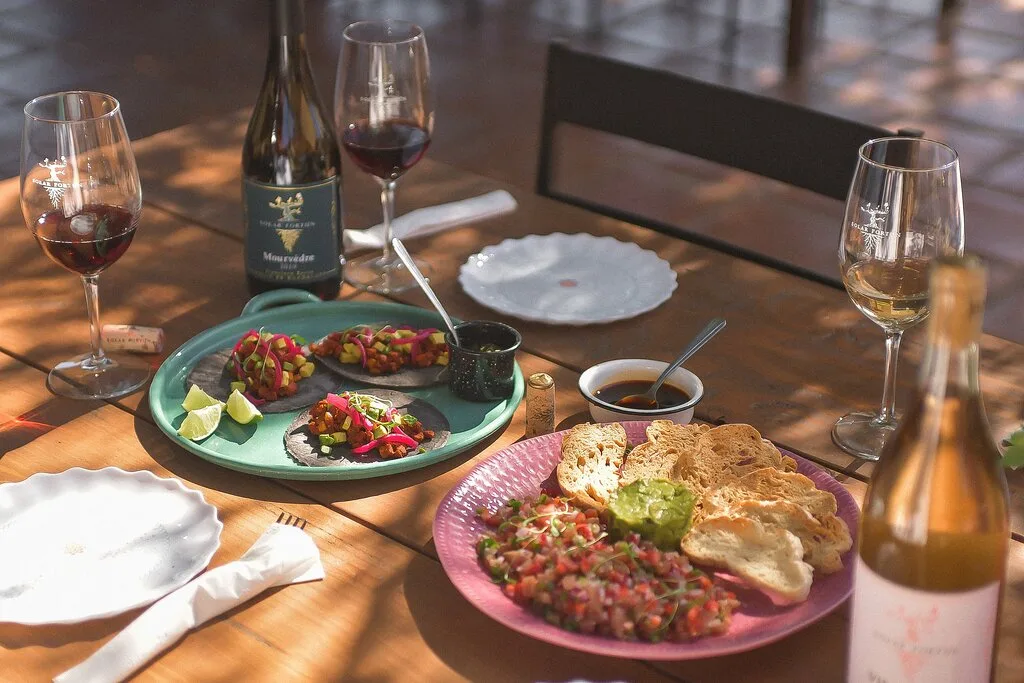
Tannin also changes with what you eat. According to the Wine & Spirit Education Trust (WSET), the salt and acidity of a dish make wine feel less astringent and more fruity, while sweetness and heat harden it. That is why a red that rasps alone can turn friendly next to tacos with lime and salt, and the same wine can feel harsh beside a sweet mole. We explain it dish by dish in our guide to pairing wine with Mexican food.
What makes a wine sweet?
During fermentation, yeasts transform the sugar in the must into alcohol. If they consume almost all of it, the wine ends up dry. If fermentation stops earlier, residual sugar remains and the wine is sweet, with less alcohol than it would have had. Almost all table reds are made dry: the yeasts work to the end.
To get a sweet wine, wineries use three main roads:
- Late harvest. The grapes are left on the vine weeks after the usual harvest. They lose water, shrivel and concentrate their sugar. In the winery, fermentation is stopped before the yeasts finish it all.
- Grape drying (pasificación). The grapes are picked and dried in baskets or hung in ventilated places before fermenting. This is where the wines called passito come from.
- Fortification. Midway through fermentation, a high-proof spirit is added that stops the yeasts' work: the wine keeps part of its sugar and rises in alcohol. This is how port and other fortified wines are made.
How can you tell whether there is sugar? Look at the texture and the finish. A wine with residual sugar leaves a rich, oily feeling, like juice or honey, that lingers after swallowing. A dry one, however fruity it smells, finishes clean and a little dry.
The Mexican standard for alcoholic beverages, NOM-199-SCFI-2017, classifies wine into four types according to its sugar content. In practice, when a label says semiseco (semi-dry), semidulce (semi-sweet), dulce (sweet), cosecha tardía (late harvest) or tipo oporto (port style), it is talking about sugar, not softness.
Why can a dry red seem sweet?
Because the nose tricks the mouth. A dry red with very ripe fruit smells of jam, red berries or plum, and those aromas are associated with sweetness. The barrel adds notes of vanilla or coconut that evoke desserts. On the tongue, though, there is no sugar. If you pay attention, the finish is dry.
Temperature pushes in the same direction. According to the Organización de Consumidores y Usuarios (OCU), Spain's consumer organization, when wine goes above 68°F (20°C) the alcohol shows more and sweet flavors are accentuated, so a red served warm can seem sweeter and heavier than it is. A young red served cool, between 54 and 57°F (12 and 14°C) according to a good part of the serving guides, shows its freshness and fruit better. Too cold, it loses aroma and feels more acidic.
Tip
Test it with the same bottle: serve one glass freshly chilled in an ice bucket and another that has spent half an hour in the kitchen on a hot day. You will know, without reading anything more, how much a wine changes with temperature.
Which red should you start with if you want softness?
If what bothers you is roughness, you do not need a sweet wine. You need a low-tannin red. These clues help find it:
- Young reds, with little or no barrel. They are usually presented as joven (young) on the label or the list. Finca La Carrodilla, in Guadalupe Valley (Valle de Guadalupe), includes on its listing a young red that blends its three single-variety reds.
- Grenache. It is grown in Baja California. Las Nubes planted it in 2009 among its first acres for commercial production, and the listings for La Lomita, which makes a 100% Grenache red, Viñas de Garza and Cavas Sol y Barro also mention it. If the wine spent a long time in barrel, ask: wood adds tannin.
- Pinot Noir and Gamay, the other two low-tannin reds that Wine Folly cites. If you see one of them on the list, it is a good candidate to start with.
- A dry rosé as a bridge. It has red fruit, freshness and almost no tannin. It accustoms the palate before moving on to red.
- Cool serving. Between 54 and 57°F (12 and 14°C) for a young red: that way the fruit shines and the alcohol does not get in the way.
If you want to progress without scares, follow a four-bottle route, one per week: first a dry rosé. Then a Grenache or a young red. After that, a medium-bodied red with little barrel. At the end, an aged red. Each step raises the tannin a little, and the palate gets used to it almost without noticing.
A friendly warning: soft does not mean without character. A good light red can be as complex and as long as a robust one. It just speaks more quietly.
Which should you start with if you really want sweetness?
If you like sweet flavors, there are wines made for that, and in Mexico they exist. This is what the listings in our directory say:
- Vinícola San Patricio, in Tequisquiapan, Querétaro, lists under its Santiago Apóstol label a Tinto Seco (dry red) and a Tinto Tipo Oporto (port-style red): two reds from the same house that illustrate the difference better than any explanation.
- Bodegas de Santo Tomás, the oldest winery in Baja California according to its listing, has among its lines one called Tardos, of late harvest.
- L.A. Cetto mentions on its listing a Passito, a sweet wine made with Muscat grapes, and a line of generoso (fortified) wines.
- Bodegas Ferriño, in Cuatro Ciénegas, Coahuila, with origins in the 19th century, makes Muscat-style and sherry-style wines, as well as brandy. Ask whether the one they offer you is dry or sweet.
Catalogs change with each harvest: before you go or buy, confirm with the winery which wines it has available.
How do you serve a sweet wine?
A sweet wine served badly seems cloying. Served well, it is the end of a party. The OCU recommends serving sweet whites at around 46°F (8°C) and fortified wines near 52°F (11°C): the cold balances the sugar and the alcohol. A port-style red, which is also fortified, welcomes a similar coolness.
- A small glass and a small pour. It is a wine to drink slowly, not to fill the glass with.
- At the end of the meal. After the savory dishes, with dessert or in place of it. The Christmas Eve sobremesa (the lingering after-dinner conversation) is its big night, and in our guide to wines for the Christmas dinner we find a pairing for each dessert.
- With company of its own height. Chocolate, flan, dried fruit or a blue cheese. A sweet wine beside a dish less sweet than itself shines. Beside a sweeter one, it goes dull and tastes sour.
Which wine should you choose based on what you already like?
Your everyday tastes are better guides than any list of awards. Some equivalences to orient you:
- If you sweeten your coffee or prefer soft drinks: start with a truly sweet wine, late harvest or port style, in small portions.
- If very strong tea bothers you: a young low-tannin red, like a Grenache, served cool.
- If you like fruit but not sugar: a dry rosé or a fruity young red.
- If you like agua de jamaica (hibiscus water) or tamarind water: yours is acidity. Look for a dry rosé or a young, fresh red.
- If you enjoy dark chocolate or whole-bean coffee: you are ready for reds with more structure and time in barrel.
- If bubbles are your thing: a sparkling wine. Its sugar levels, from brut nature to sweet, are explained in our guide to classifying sparkling wines.
How do you ask for it at a store or a winery?
Three phrases that save you misunderstandings. In Mexico, say them in Spanish:
- Busco un tinto seco, con poco tanino, que no me seque la boca. (I am looking for a dry red with little tannin that does not dry out my mouth.)
- Busco un vino dulce para el postre. (I am looking for a sweet wine for dessert.)
- ¿Este vino es seco o tiene azúcar residual? (Is this wine dry or does it have residual sugar?)
And two clues on the bottle. Words like joven (young), or a grape like Grenache, point toward softness. Cosecha tardía (late harvest), tipo oporto (port style), semidulce (semi-sweet) or dulce (sweet) point toward sugar. Generoso (fortified), on the other hand, indicates a fortified wine that can be dry or sweet, so it is always worth asking.
To settle doubts at home, put together a mini tasting with three Mexican bottles: a dry rosé, a young red and a sweet wine. Serve them in that order, taste each one alone and then with a bite, and note which one you would repeat. If you want a sheet to take notes on, it is in our guide to tasting wine. And if you prefer to try them where they were born, look in the directory of Mexican wineries (in Spanish) for a house near your next trip.
Share this story with whoever travels with you.