Routes and getawaysBaja CaliforniaQuerétaro
Guadalupe Valley or Querétaro: How to Choose Your Wine Route
Guadalupe Valley or Querétaro? We compare distances, wines, prices, days needed and atmosphere so you can pick the wine route that suits you.

When someone asks where to start getting to know Mexican wine, the conversation always ends at the same crossroads: Guadalupe Valley (Valle de Guadalupe) in Baja California, Mexico, or Querétaro. Baja California is the state with the most wineries in this directory and Querétaro is the route closest to the capital, and between the two they share a good part of the weekends of curious wine travelers. Choosing between them is the right question, and it has a different answer for each traveler.
The short answer: Guadalupe Valley is the immersion trip (sea, desert, chef-driven cooking and powerful reds), while the Querétaro route is the quick getaway from the center of the country, a specialist in sparkling wines with everything within an hour. They are two different trips that meet in the glass, and each suits a different traveler.
This comparison goes point by point: distances and access, what wines each region makes, what the trip costs, how many days each one asks for and which traveler fits each road. In the end, you will most likely want both. The order in which you do them is what is decided here.
How far is each wine route?
This is where the first difference plays out, and it is big. Guadalupe Valley opens up from Tijuana: from the city to the center of the valley it is about 65 miles (105 km), covered in 1.5 to 2 hours on the scenic highway (distance and times reported by N+ in July 2026). From Ensenada the valley is about 12 miles (20 km) away. For someone who lives in the north of the country or crosses from California, it is the backyard. For the rest of Mexico it means flying to Tijuana or San Diego and adding road time.
The Querétaro route plays in another league of closeness: Tequisquiapan is 22 miles (36 km) and about 40 minutes from Querétaro city (estimate from Uber routes, September 2026), and 116 miles (186 km) and around 2.5 hours from Mexico City (El Heraldo de México, August 2026). For the half of the country that lives in the center, it is a one-day getaway with no airport in between. In fact, it appears in the guide to vineyards near Mexico City.
If your starting point is the Bajío or the north, the scale evens out: from León, Guadalajara or San Luis Potosí, Querétaro still wins on distance, but the valley becomes reachable with a short flight. Whoever chooses by closeness almost always chooses Querétaro first, and whoever chooses by landscape usually waits for the long trip to the Pacific.
What wines will you taste in each region?
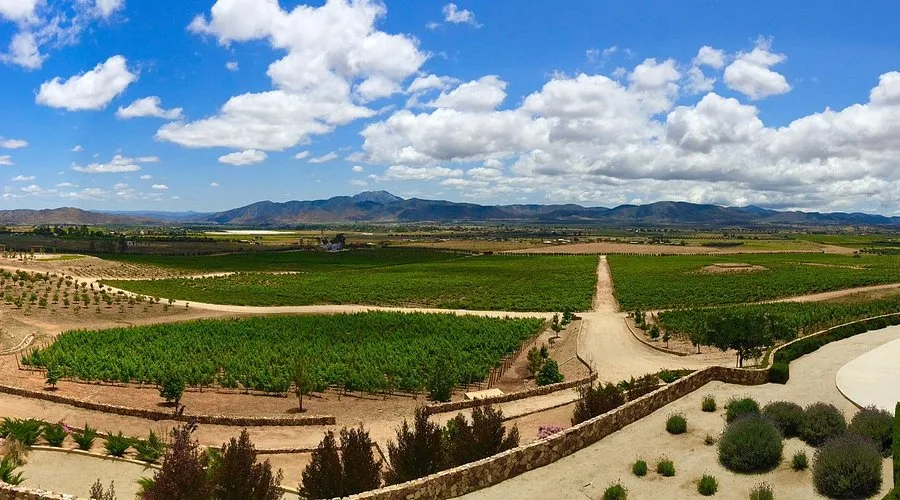
Guadalupe Valley is a land of reds with character: Tempranillo, Cabernet Sauvignon, Syrah and house blends that look like nothing else, with an ampelographic curiosity in the mix: the Mexican Nebbiolo, which DNA studies show to be something other than its name. The nearby Pacific gives cool nights that hold the acidity, and the region's experimental tradition means it is not rare to find a surprise: an orange wine, a pét-nat, an uncommon grape. Houses like Monte Xanic are among the Baja California profiles on this site to begin getting to know the zone.
Querétaro tells another story: the story of altitude. Its vineyards sit between 5,910 and 6,890 ft (1,800 and 2,100 m) above sea level, 6,400 ft (1,950 m) on average according to the state tourism portal, and at about 20 degrees north latitude, close to the tropics. That altitude gives grapes with natural acidity, and that acidity explains the local specialty: sparkling wines, a tradition that arrived through houses like Finca Sala Vivé by Freixenet Mexico and is continued today by projects such as Puerta del Lobo and De Cote Casa Vitivinícola. The guide to Mexican sparkling wines helps you arrive with the lesson read. Since March 2025 its wines also carry the first protected geographical indication of Mexican wine: Vinos de la Región Vitivinícola de Querétaro (Wines of the Querétaro Winegrowing Region), which the IMPI (Mexican Institute of Industrial Property) declared in the Diario Oficial (the official gazette) on March 10.
Querétaro also works in high-altitude reds (Malbec, Syrah, Cabernet), and the cheese and wine route shows the offer by municipality. But the practical rule holds: if you dream of intense reds and chef-driven cooking, the valley. If you like bubbles and fresh whites, Querétaro.
How much does the trip cost on each?
In the valley, as of October 2026, an entry-level tasting costs 250 to about 660 pesos per person according to the rates the wineries publish, and experiences with a tour or pairing cost considerably more. The heavy spending on the trip, however, is not the glass: it is the flight, the hotel and the dinner. The note on what it costs to travel to Guadalupe Valley breaks down the full budget, and the one on affordable wineries in the valley shows how to lower the tasting line.
Querétaro comes out friendlier on almost every line: the transfer from Mexico City is a tank of gas and highway tolls, not a plane ticket, and the route fits in a day without paying for lodging. The cost of tastings varies by house and season, so confirm it on each winery's profile before you leave.
The honest comparison: a weekend in the valley for two people can cost the same as several Querétaro getaways from the capital. It is not an argument against the valley (the trip is worth it), but it is a fact for ordering the calendar and the wallet.
The road detail of the trip to the valley: the toll on the Escénica scenic highway costs 152 pesos each way (CAPUFE rate, the federal toll agency, reported by N+ in July 2026), and it has to be budgeted round trip if you enter through Tijuana. On the Querétaro route the tolls from Mexico City also add up, but the whole trip is still from city to town, not flight plus rental car.
How many days does each route need?
Guadalupe Valley does poorly as an express visit: the long trip to get there calls for staying, and two full days are the minimum to cover two zones without hurry. The weekend itinerary for the valley spreads the days by zone, and anyone who can stay a third day sleeps inside the valley. The wineries with lodging are among the stays with the most character in the country.
The Querétaro route adapts to the time you have: one day is enough for two or three wineries and lunch in Tequisquiapan, and two days let you add the Peña de Bernal, the cheeses of the area and downtown Santiago de Querétaro. It is the route of the spontaneous weekend, the one decided on a Thursday night and tried out on Saturday.
That flexibility has a cumulative effect: whoever lives nearby can go back again and again, get to know the route by municipality (Tequisquiapan, Ezequiel Montes, Colón, El Marqués) and become a frequent visitor of their favorite houses. The valley, on the other hand, is lived as an annual or special-occasion trip: each visit is planned and celebrated more, but repeated less.
What is there beyond the glass?
The valley adds one of the most talked-about chef-driven restaurant scenes in the country (ingredient-led cooking, fire and sea), besides the landscape itself: vineyards against the desert and sunsets that close any day. For historical context, the Museo de la Vid y el Vino (Museum of the Vine and Wine) tells the winegrowing history of the peninsula. The big party comes with the August harvest, when the whole region steps out into the garden.
Querétaro answers with towns: the plaza and the old mansions of Tequisquiapan, the Peña de Bernal and its monolith, the cheese route that accompanies the wine one and, on the way back, the historic center of the capital, a World Heritage site. It is a more varied trip for groups where not everyone tastes: while some try the sparkling wine, others tour the town.
In both cases, the plan improves when the wine shares the table with its surroundings: in the valley, with the seafood and vegetables of the coast, and in Querétaro, with the cheeses of the region, which have been pairing with the local bubbles for decades. Anyone who travels only for the tastings misses half the argument of each route.
Which route suits each type of traveler?
With the comparison done, the split looks like this:
- First wine route, leaving from Mexico City or the Bajío: Querétaro. One day, low spending and sparkling wines to start.
- Total immersion trip, with budget and days: the valley. Two or three nights, reds and chef-driven cooking.
- A couple celebrating something: either one, but sleeping inside the valley raises the stakes.
- A mixed group where not everyone drinks: Querétaro, for the towns and the Peña de Bernal on the way back.
- A wine drinker who already knows the basics of Mexican wine: the valley, for its experimental edge.
- Tight budget: Querétaro first, the valley when the savings mature.
Tip
If the decision is still a tie, decide by calendar. A single day points to Querétaro, and a long holiday weekend or three days or more point to the valley. Geography settles what taste cannot break.
What dates are best for each?
Both regions harvest in summer, but the visiting calendar behaves differently. The valley has its high season in August, with the harvest festivals and hotels full weeks ahead. The note on the best time to visit the valley details the weather month by month and proposes October and May as the golden months. The wine events calendar on this site confirms the dates for each season.
Querétaro, because of its closeness to the center of the country, works as a getaway all year: spring and fall give the mildest days, and summer brings the harvest festivals to the towns along the route. In both regions, the high-season rule is the same: book tastings and lodging ahead and arrive early at the first stop.
There is a climate nuance that tilts full weekends: Querétaro's altitude cools the nights even in summer, so it is worth bringing a layer for outdoor tastings as the evening falls. In the valley, the Pacific breeze does the same job. In both, a summer midday calls for shade, water and a slow pace between glasses.
Do you have to choose, or can you do both?
Both, and the order matters less than it seems: they are complementary trips. Many Mexican wine drinkers begin with Querétaro on an ordinary weekend and land months later in the valley for the long trip. Others go the other way around and then realize they have the small route two hours from home. The guide to wine routes of Mexico, state by state shows that there is much more beyond these two (Coahuila, Guanajuato, Aguascalientes) for when both are already familiar territory.
What does not change on either one: tasting means not driving. The guide to touring the wine route without driving covers tours, hired drivers and taxis in both regions. And if you want to see the full offer before deciding, the profiles for Baja California and for the Querétaro region are the best starting point. Wherever you start, Mexican wine wins.
Share this story with whoever travels with you.