Mexican wines and grapesBaja CaliforniaCoahuila
Mission Grape: The First Grape of the Americas and Its Return to Mexican Wine
The Mission grape arrived with friars in the sixteenth century, was the base of the first American wine and returns today in bottles from Mexican wineries.

Before Cabernet, before Tempranillo, before Guadalupe Valley (Valle de Guadalupe) in Baja California, Mexico, existed on the wine map, the Americas already had a grape: the Mission grape. It arrived with the friars in the sixteenth century, was planted wherever there was a mission, from Coahuila to California, was for centuries the main grape of American wine and was then pushed aside by French varieties. Today it is returning to labels.
Knowing it puts many pieces in order: why wine in Mexico was born in convents, why Parras and the missions of Baja California are the cradle of Mexican wine and why several natural wine producers work with it today. This is its story, with the nuances that recent research demands and the bottles where you can taste it.
A note on method before we start: the historical ampelography (the study of grape varieties) of Mexico has no official searchable portal, so the technical part of this note rests on trade press that cites the UC Davis records and the INAH studies. Where the source is secondary, the text says so. The complete reference sheet is at the end.
What is the Mission grape?
It is a variety of *Vitis vinifera*, the European wine vine, known internationally as Listán Prieto, originally from Spain, and renamed in every corner of the Americas: Misión in Mexico and California, País in Chile, Criolla Chica in Argentina. The UC Davis record places its introduction to the New World by Franciscan and Jesuit missionaries between 1520 and 1540 (varietal summary cited by Kavasoft, 2026).
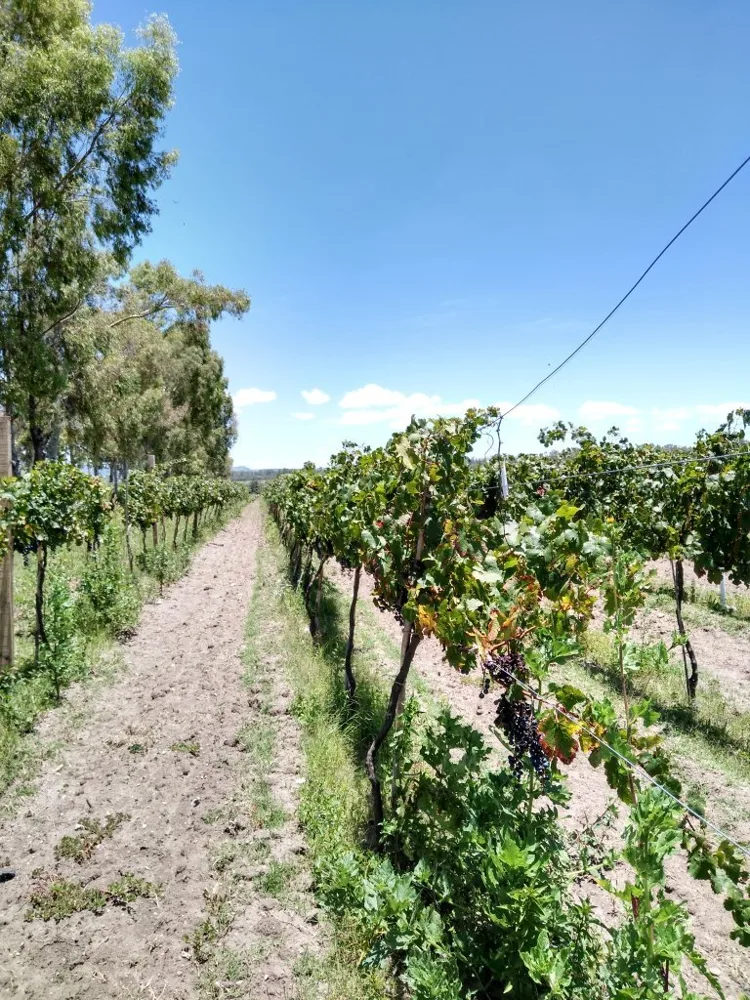
The plant is remarkably hardy: it withstands drought, heat and poor soils, and produces abundant clusters of dark grapes. That toughness, more than its elegance, helps explain its colonial success: where other vines failed, the Mission grape gave wine.
In the glass it gives wines of light color, moderate alcohol, friendly acidity and aromas of simple red fruit and sweet spice. For centuries it was also the raw material for everything else: Mass wine, table wine, aguardiente (a distilled spirit) and even vinegar.
That it is the same vine across the continent was confirmed only in recent decades, when ampelographic DNA studies connected the dots: what each country called by its own name was a single traveling variety. That revelation changed its status: from a second-rate grape it became an American genetic heritage, a variety with almost five hundred years of adaptation to the climates of the continent.
How did the Mission grape reach Mexico?
With evangelization. Wine was indispensable for Mass, and bringing it from Spain was expensive and unreliable: ships took months and part of the cargo arrived turned to vinegar. The friars needed to produce locally, and the Crown needed the friars to sustain the colonial presence. The grape traveled in that package.
The European vine had failed first in the Caribbean (Columbus took it in 1493 and the tropical climate did not let it thrive), and in New Spain it was planted from the early years of the colony: Cortés issued ordinances requiring vines to be planted after the conquest (El Financiero, 2023). From the convents of the center of the country, the vine later traveled north with each new mission foundation.
An important point of historical honesty: telling this story only as the adventure of the friars leaves out the Indigenous communities whose labor, voluntary or forced depending on the context, sustained the mission vineyards, and whose lands and water made cultivation possible. The vine is European. The wine it produced, American.
Nor is it wise to carry dates from one region to another: the chronology of the vine in central New Spain and that of the peninsular missions describe different scales, separated by more than a century. Each valley has its own planting date, and it is regional research that documents it.
Why is it called Mission?
Because it grew where a mission grew. In the northern part of New Spain, every religious foundation had its orchard, its irrigation ditch and its grapevine, and the vine became so inseparable from the system that it took its name. On the Baja California peninsula, INAH studies place the building of the mission system from the late seventeenth century and the first half of the eighteenth, with the availability of water as a decisive condition, and with it, the grapevine (Kavasoft, 2026).
From those peninsular missions the grape kept moving north: the whole history of California wine begins with Mission cuttings planted at the missions of Alta California, where the vine dominated the vineyards well into the nineteenth century. Its original name, Listán Prieto, was forgotten for generations. Only modern ampelographic research reconnected the Mexican Mission grape with the Spanish Listán Prieto and the Chilean País.
That route explains a curiosity in wine books: for a long time, the Mission grape was studied as the grape of California without looking south, when the real path was the reverse, from New Spain toward the north, mission after mission. Ampelography and archive history have been correcting that perspective: California inherited its first grape from Mexico.
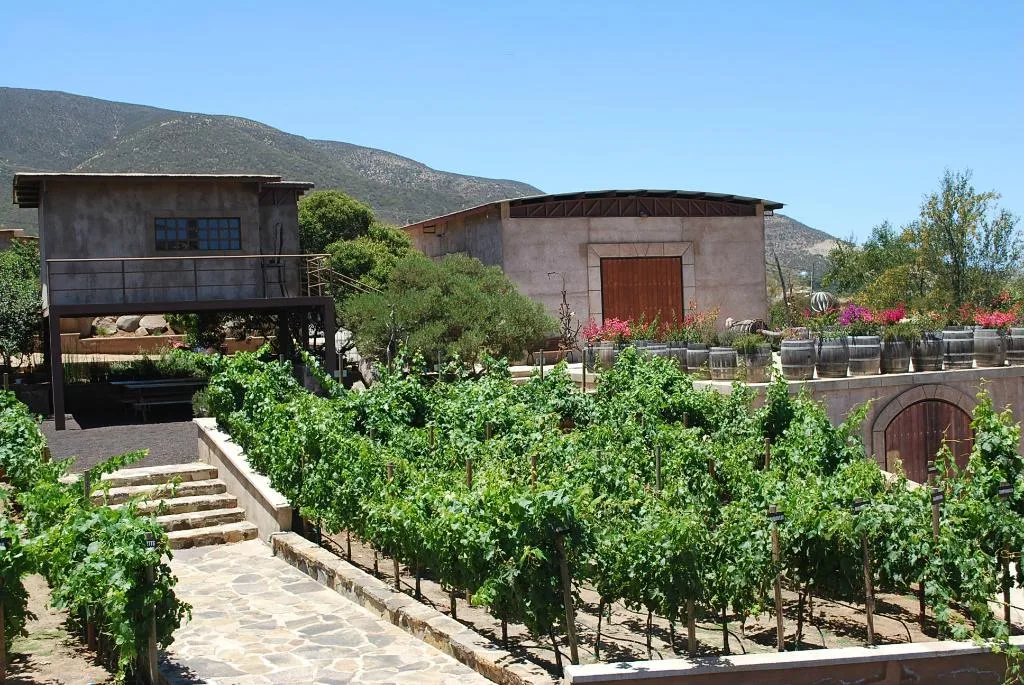
In San Antonio de las Minas, Misiones de California built its cellar with the silhouette of a Franciscan mission, as a nod to the friars who brought the vine to the peninsula, although its flagship grape is Cabernet Franc. The Mission grape itself is still alive very close by: at La Casa Vieja, also in San Antonio de las Minas, there are Mission and Palomino vines more than a century old, planted on their own roots, ungrafted.
What happened to the Mission grape after Independence?
Three blows nearly erased it. The first was secularization: when the missions disappeared in the nineteenth century, the vineyards that depended on them were abandoned or left in hands that did not always care for them. The second was the arrival of the fine European varieties, Cabernet, Tempranillo, Chenin, which the new winegrowers of the twentieth century preferred in order to compete on quality. The third was its own reputation: the Mission grape became associated with rustic jug wine, and for decades few defended it.
It survived in old dry-farmed vines in the north of the country, in shoots in ranch courtyards and in loose rows that nobody pulled up because they still gave table grapes or homemade wine. Some of those old vines, many decades old, are what the new-generation wineries now look for plot by plot.
What the twentieth century saw as an inferior grape is now seen as a resource that is hard to replace: an old vineyard cannot be planted again at will, and its value lies in accumulated years and in roots that reach down to where there is moisture.
Why is the Mission grape coming back?
Because part of the wine world changed its values: besides power and technical perfection, people now look for history, identity and low intervention, and the Mission grape has all three. Several natural wine producers work with it: old dry-farmed vines, with no chemicals and centuries of adaptation to the place, are exactly what that philosophy seeks.
The most cited example is Bichi Wines, in Tecate. The Téllez family, who came from Sonora, began bottling in 2014 with the French winemaker Louis-Antoine Luyt, who works País (the same grape) in Chile and encouraged them to look for old Mission vines (RAW WINE). Today they grow it among their varieties and bottle it, alone or in blends, under labels sold in natural wine shops in several countries (Kavasoft, 2026). Something similar happens with La Casa Vieja, whose wines with no added sulfites have found an audience in natural wine shops in the United States.
The climate argument also weighs: a vine that withstands drought and extreme heat makes sense in a country with little water.
And there is a third driver, a cultural one: drinking Mission is the most direct way to drink Mexican history. The same glass you raise today in a bar in the Condesa neighborhood is kin to the one served in a seventeenth-century convent, and that continuity, with all its colonial contradictions included, is an argument that no grape that arrived in the twentieth century can offer.
What does Mission grape wine taste like?
With careful winemaking, the Mission grape gives light, fresh reds: transparent ruby color, aromas of wild strawberry, tart cherry, dry herbs and an earthy background, with moderate alcohol and soft tannin. It is a thirst-quenching wine for long tables, more than a wine for aging or concentration.
You will also find it in pale rosés, in pét-nats and in blends where it contributes freshness and acidity. It is best tasted without comparing it to the vines made for aging. The guide to how to taste wine gives you the method.
At the table, its lightness is its advantage: it is the red that fits where a heavy red is too much. Shrimp aguachile, carnitas tacos, fresh cheese with tomato, a plate of frijoles de la olla (pot beans) with all the trimmings: the everyday cooking, which is exactly the cooking it lived alongside for centuries.
Tip
Serve the Mission grape slightly cool, at 57 to 61°F (14 to 16°C), like a light young red. It is the temperature where its red fruit and its freshness show as they are.
Where can you taste Mission grape wines in Mexico?
The Mission route is the route of its history. In Baja California, new-generation wineries around Tecate and Guadalupe Valley work with it from old vines. The profiles for the Baja California region are the directory for asking for contact and finding out who has a Mission label in the current vintage. In Coahuila, the Parras valley holds the oldest history: that is where Casa Madero is, born of a land grant from 1597. The note on the wineries of Parras organizes the visit.
To taste it without leaving the city, ask for a Mission label at a wine shop that specializes in Mexican wine. The ones we have reviewed are in places (in Spanish). And if the history of wine in Mexico has caught you, the Museo de la Vid y el Vino (Museum of the Vine and Wine) in Guadalupe Valley and the note on the wine prohibition in New Spain are the next two readings on the road.
The Mission grape lasted five hundred years without anyone caring for it much. What it lacks now is people who ask where it comes from when they pour it. The next time you see its name on a back label, you will know what story it carries.
Share this story with whoever travels with you.